The following is taken from a 'Note' I wrote on Facebook in February 2009. I thought I'd repost it, since I'm less likely to forget about it here. It is, as I note at the end, very much an early-morning ramble or rant, but hey, it's helpful for thinking about things.
The question at hand (let's make this clear) is
What makes good art?
That's what makes GOOD art, not just what makes art. Nota bene.
Theories
Okay, the usual three-way division is still relevant here. What is at question is what we should consider when judging the quality of art. I'll outline the three main categories of viewpoint (there are others, some cynical and some highly romanticized) using Wikipedia articles to draw on structure and examples, and also to try and cover many bases.
Relativism
The thesis of the aesthetic relativist is that aesthetic quality (a.k.a. 'beauty', but more on that later) is sufficiently heavily dependent on individuals' feelings towards and experiences of other individuals that there can be no consistent objective assessment of art.
Many influential philosophers - people like Kant - subscribe(d) to this theory, based essentially on the strong evidence that more or less any two people will disagree about the quality of some piece of art. The most obvious influence on this variation is probably that of the culture. This is essentially the argument espoused by many analysts of the semiotics of ideal beauty. Semiotics is essentially the study of symbology, in which anthropologists (and other professionals, especially linguists) examine how various signs acquire their meaning - John Locke was one of the first people to clearly outline the study of the topic.
Objectivism
The general position of objectivists is that it is possible to salvage something of an objective value judgement to analyze art, and that although the objective position is still deeply tied to humanity, this tie does not restrict us to the purely relativistic beliefs. See A Primer on the Objectivist Esthetics for some introductory points. Ayn Rand, the foremother of objectivism herself, said that concepts and values are
determined by the nature of reality, but to be discovered by man's mind.
If differences of opinion are the 'obvious evidence' for relativism, then the 'obvious evidence' for objectivism is that "it is not a contradiction to say: 'This is a great work of art, but I don't like it'," in the words of Ayn Rand. Therefore, there exist some criteria which can be used to discriminate between good, bad and non- art.
A major premise of many objectivists is, in fact, frequently an appeal to semiotics and symbolism - in one very intriguing sense. This is that art is an efficient way of packaging various complex notions into - well, manageable chunks, almost (I really recommend "Why Do We Have Art?" at the above link.) As I suggested in my recent note on poetry, our ability to condense metaphysics, emotions and so on into small packages in fact elucidates them. After all, our cognitive ability is almost entirely associative in nature, and as such is greatly stimulated by complex, interwoven representations of topics. People do tend to love the way that a topic is composed of many different (often seemingly incompatible) strands which can be brought together into cohesive, pleasing (there's that aesthetic appeal) structures.
This is actually quite an inclusive, if no doubt dissatisfyingly vague, definition - it includes art reflecting on (read: containing - most artists spend a LONG TIME thinking about how their art relates to their subject matter, and so do consequently most critics - but this is not necessary for the full enjoyment of the piece) natural beauty, and manufactured beauty (as I say, more on beauty later), probably speeches and anything containing metaphor, and so on. And we can also conceive of ways of comparing quality - according to the criteria in the above link, for example. However, personally I find these criteria rather vague and limiting. Mainly "Clarity", which I think is of debatable value.
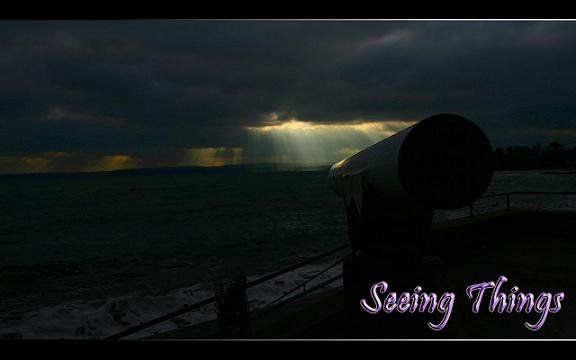 Of course, this label has little to say about, for example, true abstract art, or many types of post-modernist art. It also has an interesting problem with photography, which I suspect is of interest to the readers of this essay. Namely, that people often regard photographs as art when they were, in reality, little more than snaps - a phenomenon particularly prevalent in the field of wildlife photography. This also touches upon the problems of art without the artist, and leads us naturally on to natural beauty and such topics... But there's no space for that here. See below!
As far as abstract art goes, I find it unintuitive that it can be included in this category - and music has a similar problem. This is where we discuss whether art must be representational - i.e., whether it must be a symbol of something. First, we turn once more to Rand:
As a re-creation of reality, a work of art has to be representational; its freedom of stylization is limited by the requirement of intelligibility; if it does not present an intelligible subject, it ceases to be art.
This certainly seems to say no. I suspect Ben might sympathize with the viewpoint expressed in the above statement, since he has a fairly pragmatic approach to such high-brow concepts (I don't think it is necessarily high-brow) as art, and since he considers things which need study and background to be less worthwhile.
But -- let me look at music first. If you read books like The Rest is Noise: Listening to the Twentieth Century (by Alex Ross) , or biographies of most 'classical' music composers, then you start to find out about lots and lots of symbolism buried in the history and personal stories of the composers. There are obvious and subtle motifs, and the question as to whether such cultural and subtle representations are deemed acceptable is moot. I don't see how you can deny it. Decent music with lyrics tends to be as metaphorical as poetry, if not as considered.
Abstract art is a more awkward prospect. I personally don't rate a lot of abstract art very highly, so I won't discuss it.
Realism
This viewpoint is held by those who insist that aesthetic value - often termed beauty (see below) - is a concept completely independent of humans.
Beauty
To quote the Simpsons, "Beauty is truth, truth beauty" (Keats) -- 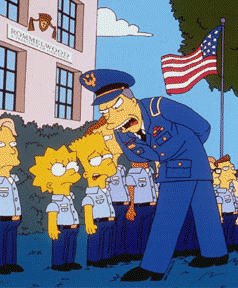
But the truth can be harsh and disturbing! How can that be considered beautiful?
Often, we abbreviate much of aesthetic quality into the term 'beauty', in a rather uppity sense. Take the first line of Wikipedia:
Beauty is a characteristic of a person, place, object, or idea that provides a perceptual experience of pleasure, meaning, or satisfaction
Or the OED, which gives this as an additional definition to visual attractiveness:
That quality or combination of qualities which affords keen pleasure to other senses (e.g. that of hearing), or which charms the intellectual or moral faculties, through inherent grace, or fitness to a desired end
These get at the empathetic nature of beauty, to my mind. The point is that the object in question evokes some degree of some variety of resonant satisfaction in our mind (I use 'resonant' advisedly; memory and thought seem to work by resonating neuron networks.)
Anyway, the interesting thing is what makes beauty; and I think that there are different categories of beauty. Here are some, mainly focusing on the visual arts:
Beauty of the human (and to some degree other animal) form
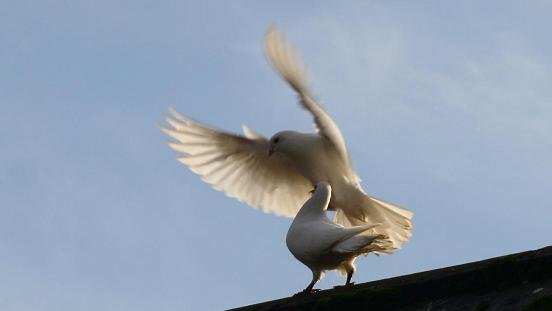
This kind of beauty - a respect for various qualities ranging from elegance, healthiness, calmness, and happiness to that found in sexually provocative material - is probably derived largely from the evolutionary advantage of being able to pick out fertile and healthy mates - there is conclusive evidence, for instance, that in women, a waist-to-hip ratio of 0.7 is a good predictor of both attractiveness and fertility. In animals, it makes sense that we look for similar attributes - like the elegance and pure colour of the wings of the dove I snapped above - in judging beauty.
Beauty of animals and the inanimate object (including devices or tools, and statues)
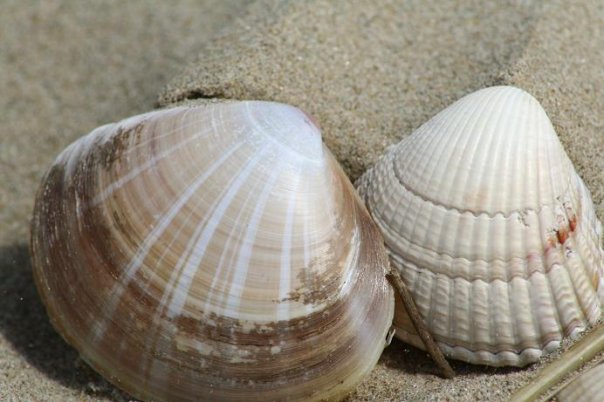
This type of beauty often has appeals between several of the other categories here - as well as the appeal discussed under the human/animal form discussion, we see the appeal of patterns and so on.
Beauty of the landscape, skyscape, seascape... etc.

This is a much more subtle form of beauty. There is a definite need to look to the multifarious views of our philosophical betters. For example, look at Burke, who divides aesthetic appeal into masculine and feminine components (being a man...) He declares the sublime to be the masculine element, which overwhelms the viewer with power, scale, uniformity, abruptness, difficulty, intense colours, etc. and argues that the language of the sublime is muddled, not descriptive, emotionally abstract, and full of conflicting sensations. Contrastingly, he defines beauty as the feminine element, which overwhelms the viewer with the wish to protect the subject, and is characterized by symmetry, intricateness, smoothness, mildness, attractiveness (in a metrosexual way!) and so on. Burke wondered if the beautiful was appealing to evolutionary elements of sexual desire, and the sublime - but terrifying - to our instinct for self-preservation in some way.
A highly important concept in aesthetics (particularly the 18th century) is the picturesque, literally that which is fit to be made into a picture or which is in the style of a picture - it is a term considered to unite the sublime and the beautiful as Burke considered his extremes, and classically taking the form of the idealized rural landscape painting, with stern elements like crags, ruins or torrents, and softer elements like a quiet - vulnerable - cottage, a gentle winding river or a soft forest. This concept of the picturesque sheds some light, I feel, on how we relate to landscapes and many other works of art.
Beauty of colour, patterns and shape
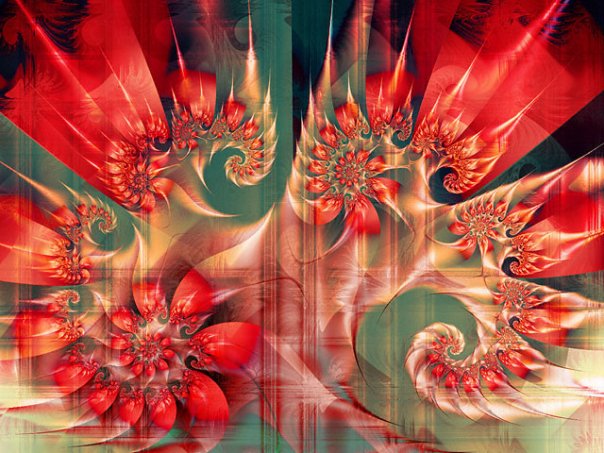
The subtleties of these forms are essentially those of abstract art, and as such are in some ways difficult to pin down. However, using the tools developed using our landscape analysis, perhaps some elements are already separated.
The human instinct to spot patterns - and the satisfaction we experience when we use this ability - seems to help us gain pleasure from fractal-based images like that above. We seem to particularly like subtle or obscured patterns. This seems to be reasonable, given we have evolved highly specialized symbolic and pattern-spotting mechanisms, and since our culture is set up to teach young children that spotting things is good.
Beauty of abstract consistency and bringing together of disparate thoughts (particularly mathematical beauty)
(See the Wikipedia articles on Mathematical Beauty and Mathematics and Art.)
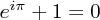


It is surely a related type of satisfaction which we can gain from understanding the mysterious patterns and intricacies of a consistent theory. We do love it like a good story when things come together, in quite a literal sense.
Summary
So why have I gone on about beauty, and where does it leave us?
Well, my argument is that the aesthetic value of a piece of art qua art is based entirely on its beauty, as defined above:
That quality or combination of qualities which affords keen pleasure to the senses, or which charms the intellectual or moral faculties, through inherent grace, or fitness to a desired end
And as such it is essentially a relativist concept, and every individual can have their own response to any of the terms in the above definition. However, I dispute that this makes the concept of art useless. Apart from giving us this definition of the value of art (I'll discuss value in just a minute) this discussion also indicates how culturally dependent and how dependent on human nature the notion of art is, since (as we observed above) various elements of beauty are a consequence of biological (neurological) or cultural influences.
As far as investigating 'good art', i.e. judging its quality, goes, there are two obvious possible types of criterion to judge how beautiful art is, given the above context.
- Breadth of appeal
- Intensity of appeal
That is, on how many 'levels' it works (sensually, intellectually, morally, functionally...), and how strong the sensation is. Mix and match to your own taste. I think a 50-50 split sounds good. Simple, really.
Note: You can attach value to the amount of work put into something, if you want, but be aware that split-second dives for wildlife photographs become worthless in the category, whilst a child intently (but poorly) copying trees into what I like to call a 'crapscape' gets a heck of a lot of credit.
Note: My definition of art clearly includes film, novels, songs, whatever. I can live with that. See that overly sentimental emotional flicks and childish books, whilst they may evoke strong emotions, do not really have the variety of effects the above evaluation looks for, since they are working purely on one level.
Note: I've been watching TV and stuff whilst doing this, and it's now 2:17 in the morning. I'm pretty tired and this is probably full of incomplete stuff and bollocks. Enjoy.
Wow, I wasn't kidding with that third note. Well, I can see omissions and problems already. Maybe I'll sort this out sometime.


 Mathematics
 Categories
 Contact
0 Comments